Phoenix vs Houston: Why Arizona Plumbers Are Winning Online
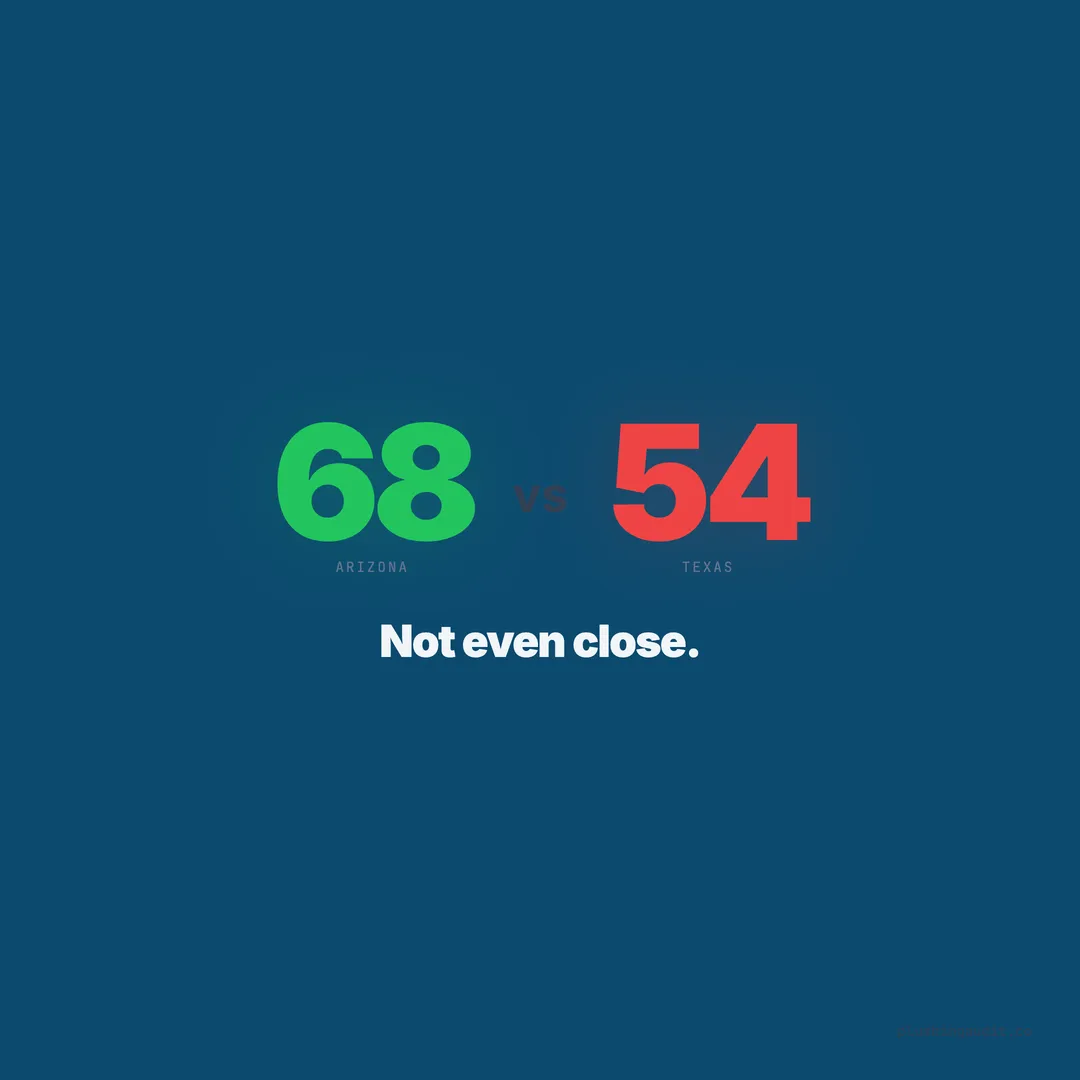
Arizona plumbing websites average 68/100 vs Texas at 54. We compare Phoenix, Gilbert, and Chandler against Houston, Dallas, and San Antonio city by city.
A plumbing company in Gilbert, Arizona scores 78 on our website audit — the highest city average in our entire national dataset. A plumbing company in Sugar Land, Texas — a Houston suburb with similar demographics, similar income levels, and similar demand — scores 28. That is a 50-point gap between two Sun Belt suburbs serving homeowners who both need pipes fixed and water heaters replaced. The difference is not the trade. It is the website.
When we audited 1,893 plumbing websites across 13 states, Arizona and Texas emerged as polar opposites. Arizona’s 132 sites average 68 out of 100 — the highest state score in our data. Texas’s 466 sites average 54 — among the lowest. The gap between these two Sun Belt powerhouses is 14 points, and it shows up in every metric we measure: security, trust signals, conversion elements, local SEO, and mobile usability.
This is not about one state being wealthier or more tech-savvy. Texas has a larger economy, more plumbing companies, and a higher volume of online searches. Arizona simply builds better plumbing websites. Here is exactly why — and what Texas plumbers can steal from their Arizona competitors.
The State-Level Numbers: 68 vs 54
Before we compare cities, the aggregate data tells a clear story.
| Metric | Arizona | Texas |
|---|---|---|
| Sites Audited | 132 | 466 |
| Average Score | 68 | 54 |
| National Rank | #1 | #11 |
| Gap vs. National Avg | +11 | -3 |
Arizona beats Texas on every aggregate measure despite having fewer than one-third the number of sites. The state’s plumbing market is smaller by every standard — fewer licensed plumbers, fewer companies, fewer total searches. Yet the websites are demonstrably better. That disparity points to something beyond market size.
Texas employs 42,290 plumbers — the second-largest workforce in the country. Arizona employs roughly a third of that number. Texas processes over 10,447 licensing exams annually, a volume that has grown 111% since 2022. The state is producing plumbers at an accelerating rate. But the websites those plumbers build are not keeping pace with the volume. More competition in Texas has not driven web quality upward — it has spread marketing budgets thin.
City-by-City: Arizona Dominates the Top of the Leaderboard
When you line up the cities side by side, Arizona occupies four of the top seven slots in our national city rankings. Texas has 23 cities in our dataset but places only two — Houston and Arlington — in the top 10.
| Rank | City | State | Score |
|---|---|---|---|
| 1 | Gilbert | AZ | 78 |
| 2 | Chandler | AZ | 71 |
| 4 | Tucson | AZ | 70 |
| 6 | Houston | TX | 68 |
| 7 | Mesa | AZ | 68 |
| 10 | Arlington | TX | 65 |
| — | Phoenix | AZ | 64 |
| — | Plano | TX | 64 |
| — | Frisco | TX | 59 |
| — | Austin | TX | 58 |
| — | Fort Worth | TX | 57 |
| — | San Antonio | TX | 56 |
| — | Dallas | TX | 50 |
| — | Irving | TX | 40 |
| — | The Woodlands | TX | 35 |
| — | Sugar Land | TX | 28 |
Gilbert at 78 versus Sugar Land at 28 is the most extreme city-to-city gap in our data. Both are affluent suburbs. Both serve homeowners with median household incomes above $100,000. Both sit within major metro areas with strong plumbing demand. The website quality gap is entirely about execution — which elements each company includes, which trust signals they display, and whether their site functions as a lead generation tool or a digital business card.
Feature Gap #1: HTTPS Adoption — 78% vs 32%
The single largest gap between Arizona and Texas plumbing websites is security. 78% of Arizona plumbing sites run on HTTPS. In Texas, that number drops to 32%. The difference is staggering — Arizona is more than double the Texas rate.
In Gilbert — the top-scoring city — 92% of sites have HTTPS. In Sugar Land — the bottom-scoring city — less than 15% do. HTTPS is not a ranking factor in isolation, but Chrome’s “Not Secure” warning destroys homeowner trust before they read a single word on the page. Our data shows that sites with HTTPS score 12-15 points higher on average than those without, making it the single highest-impact technical factor in our scoring model.
The fix is free on virtually every hosting platform. Let’s Encrypt certificates cost nothing and renew automatically. The 15-minute process removes the warning and unlocks a scoring boost that no other single change can match.
Feature Gap #2: Contact Forms — 71% vs 48%
Arizona plumbing websites are 48% more likely to have a functional contact form than Texas sites. 71% of Arizona sites include at least one web form, compared to 48% in Texas. The gap widens further in the suburbs: Gilbert sites average 84% form adoption while Sugar Land drops to 18%.
A contact form is the minimum viable conversion path for a plumbing website. It captures leads when the phone is not answered. It works at 2 AM. It gives homeowners who dislike phone calls an alternative. And it creates a record of the inquiry that your team can follow up on systematically.
Texas plumbing companies that rely exclusively on phone calls as their conversion path are losing every lead that comes in after hours. In a state where 45% of online booking requests happen between 6 PM and 8 AM, that is a massive revenue leak. Our contact form guide shows how to build one in under 20 minutes.
Feature Gap #3: Service Area Pages — 64% vs 38%
Arizona plumbing companies are far more likely to have dedicated pages for the cities they serve. 64% of Arizona sites include service area pages, compared to just 38% in Texas. This gap directly impacts local search visibility.
The Phoenix metro is geographically sprawling. Gilbert, Chandler, Mesa, Tempe, Scottsdale, and Phoenix proper are distinct cities with distinct search behavior. A homeowner in Chandler searching “plumber in Chandler” will not find a Phoenix plumber who only mentions “Phoenix metro” on their site. Arizona plumbers appear to understand this — they build pages for each city.
Texas has the same geographic challenge but does not respond to it the same way. A plumber in the DFW metroplex might serve Arlington, Irving, Dallas, Fort Worth, and Plano — five cities that each generate distinct local searches. Without dedicated service area pages for each city, that plumber is invisible in four of those five markets.
Feature Gap #4: Schema Markup — 68% vs 44%
Structured data adoption tells the most forward-looking story. 68% of Arizona plumbing sites include schema markup, compared to 44% in Texas. In an era when Google’s AI Overviews increasingly pull from structured data to generate local service answers, this gap will widen in impact over the next 12 months.
Schema markup is invisible to the homeowner visiting your site. But it speaks directly to Google’s algorithm, telling it your business name, phone number, hours, service area, and aggregate customer rating. Sites with comprehensive schema are more likely to appear in knowledge panels, local packs, and AI-generated search results.
Arizona plumbers — particularly in the Phoenix metro — appear to have adopted schema as a standard practice. When 68% of your competitors have structured data, not having it puts you at a measurable disadvantage. In Texas, where only 44% of sites have schema, the opportunity is inverted: adding schema markup gives you an edge over the majority.
Why the Gap Exists: Three Structural Explanations
The Arizona-Texas gap is too large and too consistent to be coincidental. Three structural factors explain why Arizona plumbing websites outperform Texas.
Competition density vs. competition quality. Texas has 466 plumbing websites in our audit — more than three times Arizona’s 132. But more competitors does not mean better competitors. In Texas, the sheer volume of plumbing companies means marketing budgets get spread across lead aggregators, Google Ads, truck wraps, and door hangers. The website becomes one channel among many, and it gets neglected. In Arizona, with fewer companies per capita, the website carries more weight as a lead generation tool. Companies invest accordingly.
New construction influence. Maricopa County led the nation with 38,310 new housing units built in 2024. Metro Phoenix ranks third nationally for new-home construction. New construction plumbing companies — the ones wiring up subdivisions in Gilbert and Chandler — tend to have newer, better-built websites because they launched their businesses in the digital-first era. Texas’s plumbing market includes a larger proportion of legacy companies with legacy websites.
Regional marketing culture. Arizona’s plumbing market has benefited from spillover from the state’s tech sector. Phoenix is a growing tech hub, and the local service industry absorbs digital marketing practices faster than in states where tech is less concentrated. This is anecdotal but consistent with the data: Arizona plumbing companies are more likely to use field service management software with built-in web integrations, which naturally produces higher-quality web presence.
What Houston Does Right (and What Dallas Should Copy)
Houston is the bright spot in Texas — scoring 68, it matches Arizona’s state average and outperforms Phoenix (64) on a city-to-city basis. Houston proves that Texas plumbing companies can build excellent websites. The question is why the rest of the state does not follow Houston’s lead.
Houston’s plumbing market was shaped by disaster. Hurricane Harvey in 2017 created a permanent shift in how Houston homeowners search for plumbers. Emergency demand pushed companies to build emergency pages, display after-hours availability, and invest in online booking. Those features lift scores across the board.
Dallas at 50 could replicate Houston’s approach without waiting for a disaster. The playbook is straightforward: install HTTPS, add a contact form, build service area pages for every city in the metroplex, add schema markup, and display Google reviews on the homepage. None of these changes require a full site redesign. Each one lifts the score by 5-10 points. Together, they could push a Dallas plumber from 50 to 70+ — competitive with Gilbert.
The Gilbert Blueprint: What Every Plumbing Website Should Include
Gilbert, Arizona at 78 is not an accident. It is a blueprint. The plumbing websites in Gilbert consistently include the elements that our scoring model rewards — and that homeowners reward with their business.
Every site has HTTPS. No exceptions. The “Not Secure” warning does not exist in Gilbert’s plumbing search results. That baseline security creates a level playing field where trust is built on content, not undermined by browser warnings.
Contact forms plus booking. Gilbert sites do not force phone-only conversion. They offer multiple paths: phone, form, and often online booking. This captures leads at every stage of the decision funnel — the ready-to-buy caller and the still-researching form-filler.
License numbers in the footer. Gilbert plumbers display their Arizona ROC (Registrar of Contractors) license number on every page. It takes up 20 pixels of footer space and communicates “we are legitimate” to every visitor.
Service area pages for surrounding cities. Gilbert plumbers build pages for Chandler, Mesa, Queen Creek, and San Tan Valley. They understand that local SEO requires local content, and they invest the time to build it.
Reviews on the homepage. Gilbert plumbing sites display their Google ratings and recent reviews above the fold. With an industry average of 4.79 stars, these reviews are a competitive asset — but only if homeowners can see them without searching for them.
The Action Plan for Texas Plumbers
Arizona’s 14-point lead over Texas is not permanent. It is a gap created by execution, not advantage. Texas plumbers who implement the Gilbert blueprint can close that gap in weeks, not months.
Start with our website checklist. It covers every element Gilbert sites include that Sugar Land sites miss. Then prioritize: HTTPS first, forms second, service area pages third, schema fourth, reviews fifth. Each change lifts your score incrementally, and the cumulative effect is a website that competes with the best in the country.
The tools already exist. The data already proves what works. The only question is whether you will build what Gilbert built — or keep competing with what Sugar Land has.
Keep Reading
- We Audited 1,893 Plumbing Websites. Here’s What We Found.
- Plumbing Websites in Texas: Why the Biggest Market Scores the Lowest
- Why Small-City Plumbers Are Outscoring Metro Competitors
Arizona builds better plumbing websites because Arizona plumbing companies treat their websites as lead generation tools. Texas plumbing companies — with notable exceptions like Houston — treat their websites as digital business cards. The 14-point gap is the cost of that distinction. And in a market where every missed lead is worth $445 or more, that cost compounds every single day.
Want to know your score?
Drop your URL — full report in 48 hours.
We're on it.
Report in your inbox within 48 hours.