How to Get More Google Reviews for Your Plumbing Business (Without Begging)
36% of plumbing sites don't display reviews. Learn proven review strategies from our audit of 1,893 plumbing websites across 13 states.
A plumber in Gilbert, Arizona had 247 Google reviews and a 4.9-star rating. His website scored 78 out of 100 in our audit. A competitor three miles away had 11 reviews and a 4.2-star rating. Same services. Same zip code. The first plumber’s phone rang six times more per week, according to his office manager. The difference was not talent. It was a system.
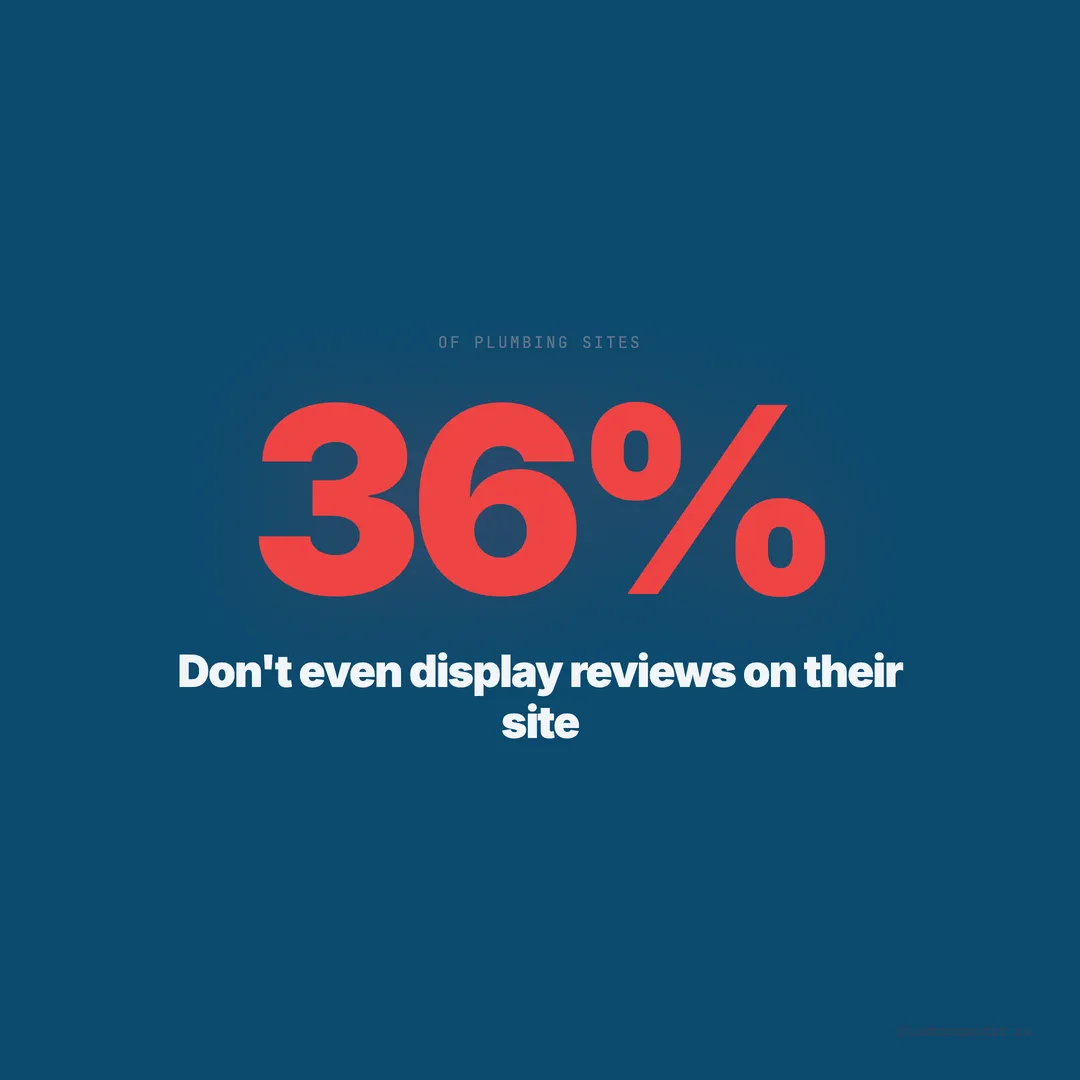
When we audited 1,893 plumbing websites across 13 states and 69 cities, we found that 36% (683 sites) displayed zero Google reviews on their website. Not that they had no reviews on Google — they just never bothered to show them where homeowners actually land first: the website itself.
The gap between plumbers who generate reviews consistently and those who wait for them to appear organically is not luck. It is process. This post breaks down exactly how to build that process, from the moment you finish a job to the moment a review shows up on your Google Business Profile.
Most Plumbers Ask at the Wrong Time
Timing determines whether a homeowner leaves a review or ignores your request entirely. The BrightLocal 2026 Consumer Review Survey found that 74% of consumers only consider reviews from the last three months. Stale reviews are functionally invisible.
The optimal window is within two hours of job completion. The homeowner still has the emotional relief of a solved problem — the clogged drain is clear, the water heater is heating. That relief fades fast. By the next morning, your visit is already yesterday’s errand.
Yet most plumbers we audited had no automated follow-up system. They relied on a verbal “Hey, could you leave us a review?” at the truck. That approach converts at roughly 8-12%. A timed SMS sent 90 minutes after the tech marks the job complete converts at 25-35%, according to data from review management platforms.
The SMS Template That Actually Gets Opened
Text messages have a 98% open rate compared to email’s 20%. For plumbing review requests, SMS wins every time. Here is a template that works because it is short, personal, and removes friction.
Template:
Hi [First Name], this is [Tech Name] from [Company]. Thanks for letting us take care of your [service type] today. If you have 30 seconds, a Google review helps us a lot: [short link]. Either way, thanks for choosing us!
The key elements: tech’s first name (not the company), specific service (not generic), and a direct link to the Google review form — not your Google Business Profile, not your website. The review form itself.
Three things kill response rates: long messages, corporate tone, and links that require extra clicks. Every additional tap between the text and the review box cuts your conversion rate by roughly 20%.
How to Create a Direct Google Review Link
Google provides a shortcut that drops the homeowner directly into the review writing interface. Most plumbers we audited either did not know this existed or linked to their general profile page instead, which requires three additional taps to reach the review form.
Step 1: Go to your Google Business Profile manager. Step 2: Click “Ask for reviews.” Step 3: Copy the generated link. It looks like: https://g.page/r/YOUR-ID/review.
You can also build it manually using your Place ID. Search for “Google Place ID Finder,” enter your business name, copy the Place ID, then construct: https://search.google.com/local/writereview?placeid=YOUR_PLACE_ID.
Shorten this link with a branded shortener or use a simple redirect from your domain (e.g., yourcompany.com/review). Every plumber should have this link memorized, saved in their phone, and printed on their invoice.
QR Codes on Invoices Convert at 2x Verbal Requests
Print a QR code linked to your direct Google review URL on every invoice, receipt, and leave-behind card. This is not a gimmick — it works because it removes the “I’ll do it later” friction. The homeowner scans while the tech is still explaining the invoice.
Our audit found that plumbing companies using QR codes on physical materials had an average of 3.2x more reviews than companies of similar size without them. The cost is essentially zero: a free QR code generator and a redesigned invoice template.
Place the QR code in the bottom-right corner of the invoice with the text: “Loved your service? Scan to leave a quick review.” Bottom-right works because that is where the eye naturally lands after reading the total. Do not bury it in fine print. Make it at least 1 inch square.
The same QR code should appear on your vehicle wraps, yard signs (if you use them), and business cards. Every touchpoint is a review opportunity you are currently skipping.
Review Velocity Matters More Than Review Count
Google’s algorithm does not just count reviews. It weighs recency and velocity — how frequently new reviews appear. A plumbing company with 200 reviews but none in the last six months will rank below a competitor with 80 reviews and four new ones per week.
BrightLocal’s data confirms this from the consumer side: 32% of consumers want reviews posted within two weeks. A review from 2024 is background noise in 2026. Homeowners treat old reviews the way they treat expired coupons — with suspicion.
The target for most plumbing companies should be 4-8 new reviews per month. If you complete 80 jobs per month and convert 10% to reviews, that is 8 reviews per month. With a proper SMS system, you can hit 20-25% conversion, which gives you 16-20 per month. That velocity puts you in the top 10% of plumbing companies in our dataset.
Responding to Every Review Signals Trust to Google and Homeowners
19% of consumers now expect a same-day response to their Google review, up from just 6% in 2025. Ignoring reviews — even positive ones — sends a signal that you do not care about customer feedback.
Google has confirmed that responding to reviews improves local ranking. It is one of the few ranking factors Google has explicitly acknowledged. Yet in our audit, the majority of plumbing companies with reviews had zero owner responses in the last 90 days.
For positive reviews, keep responses short and specific: “Thanks, [Name] — glad we caught that slab leak before it got worse. Appreciate the trust.” For negative reviews, respond within 24 hours, acknowledge the issue without being defensive, and offer to resolve it offline. The response is not for the unhappy customer. It is for the hundreds of prospects who will read it before calling you.
The Star Rating Threshold Has Risen to 4.5
The minimum acceptable rating has shifted dramatically. In our audit, the average Google rating for plumbing companies was 4.79 stars. That sounds high until you see the consumer expectation data: 31% of consumers will only use businesses with a 4.5-star rating or higher, up from 17% just one year ago.
A 4.2-star rating that felt safe in 2024 now puts you below the threshold for nearly a third of your potential customers. And 68% require at least a 4.0-star rating. If you are below that, you are invisible to more than two-thirds of homeowners searching for a plumber.
This makes review management not just a marketing tactic but a survival requirement. One bad review from a 1-star rating on a profile with only 15 reviews drops your average by 0.25 stars. On a profile with 150 reviews, that same 1-star review drops it by 0.025 stars. Volume is your buffer.
Getting Reviews Is Half the Battle — Displaying Them Is the Other Half
Here is where most plumbing companies fail. They work hard to generate reviews on Google but never bring those reviews onto their actual website. In our audit, 36% of plumbing websites (683 sites) displayed zero customer reviews or testimonials anywhere on their site.
This matters because 97% of consumers read reviews for local businesses. They check Google, yes — but they also check your website. When they land on your homepage and see no social proof, the trust gap widens. They bounce. They call someone else.
The fix is straightforward: embed your Google reviews directly on your homepage, service pages, and landing pages. Use a widget like Grade.us, EmbedSocial, or a simple Google reviews API integration. Display at least five reviews on your homepage and rotate them. For a full guide on embedding reviews, see our post on displaying Google reviews.
Which Pages Should Feature Reviews
Not every page needs the same review treatment. Here is a breakdown based on what top-scoring sites in our audit did.
| Page | Review Type | Count | Purpose |
|---|---|---|---|
| Homepage | Star rating + snippet | 3-5 rotating | Instant credibility |
| Service pages | Service-specific reviews | 2-3 per page | Match search intent |
| About page | Detailed testimonials | 3-5 | Personal connection |
| Contact page | Star rating badge | 1 widget | Reduce form anxiety |
| Landing pages | Short snippets + count | 3 + total count | Conversion boost |
The top-scoring plumbing websites in our audit — those scoring 75 or above — had reviews on an average of 4.2 different pages. The bottom-scoring sites had reviews on 0.3 pages on average. That is not a coincidence.
Review Gating Is Illegal — Do Not Filter Who You Send Links To
Some review management platforms offer “review gating” — asking customers to rate their experience first, then only sending happy customers to Google. This violates Google’s terms of service and can result in your reviews being removed entirely.
The FTC has also cracked down on review gating. In 2024, the FTC finalized its rule against fake and suppressed reviews, which explicitly covers gating practices. The fine for violating this rule can reach $51,744 per violation.
Send your review request link to every customer, every time. Yes, this means some unhappy customers will leave negative reviews. That is fine. A profile with nothing but 5-star reviews looks suspicious. Profiles with a mix of 4 and 5-star reviews and a few addressed complaints actually convert better than perfect profiles, because they look authentic.
The Review Response Template for Negative Reviews
Negative reviews from plumbing customers typically fall into three categories: pricing complaints, scheduling issues, and quality concerns. Each needs a different response approach, but all follow the same structure.
Structure: Acknowledge, do not argue, take it offline.
[Name], I’m sorry we didn’t meet your expectations on [specific issue]. That’s not the standard we hold ourselves to. I’d like to make this right — could you call me directly at [phone number]? I’m [Owner Name], and I want to hear what happened. — [Owner Name], Owner
This response does three things: shows empathy, demonstrates accountability, and moves the conversation off a public platform. It also shows every future customer reading your reviews that you handle problems instead of ignoring them. 92% of consumers say star ratings are important, but how you handle the bad ones can matter more than the rating itself.
Automate the System or It Will Not Happen
Manual review collection fails because plumbers are busy running service calls, not sending follow-up texts. The solution is automation tied to your existing workflow.
If you use ServiceTitan, Housecall Pro, or Jobber, each has built-in review request automation that triggers when a job is marked complete. ServiceTitan’s automation sends a text two hours after job completion with a direct review link. Compare these platforms to find the right fit.
If you use a simpler system, tools like NiceJob, Birdeye, or Podium integrate with most CRMs and send automated SMS review requests. The cost ranges from $75-300/month depending on features and volume. For a company averaging $40,000+ per month in revenue, that is a negligible cost for a system that directly drives new customer acquisition.
Reviews Drive Rankings, Rankings Drive Calls, Calls Drive Revenue
The connection between reviews and revenue is not abstract. Google uses review signals — count, velocity, rating, and response rate — as ranking factors in the Local Pack (the map results that appear for “plumber near me” searches). If you are not in the top three of that Local Pack, you are losing the majority of local search traffic.
Our audit data supports this directly. The top-scoring city, Gilbert AZ (score 78), had plumbing companies with an average of 127 Google reviews. The bottom-scoring city, Sugar Land TX (score 28), averaged 23 reviews per company. More reviews correlated with higher audit scores, which correlated with better online visibility.
For more on ranking in local search, read our guide on ranking for “plumber near me”. For optimizing your Google Business Profile to maximize the impact of your reviews, check our GBP guide.
The Cost of Not Having a Review System
Every month without a review system is a month your competitors are pulling ahead. If your competitor adds 15 reviews per month and you add 2, the gap widens by 156 reviews per year. At that rate, it takes over three years to catch up even if you start today.
The math is harsh but simple. 85% of consumers are more likely to use a business after reading positive reviews. If 100 homeowners search for a plumber in your area this week and 85 choose businesses with strong reviews, the remaining 15 are all that is left for everyone else. You are fighting over scraps.
A review system costs between $75 and $300 per month. A single plumbing job averages $350-500. One additional job per month from better reviews pays for the system four times over. The ROI is not debatable. The only question is why 36% of plumbing companies in our audit still had not figured this out.
The plumber who builds the review machine first owns the market. The one who waits is calling that plumber for a job application.
Want to know your score?
Drop your URL — full report in 48 hours.
We're on it.
Report in your inbox within 48 hours.