How to Create a Plumbing Maintenance Plan Page That Sells Recurring Revenue
Plumbing maintenance plans can triple customer lifetime value from $450 to $3,000+. Here's how to build a website page that actually sells them — with data.
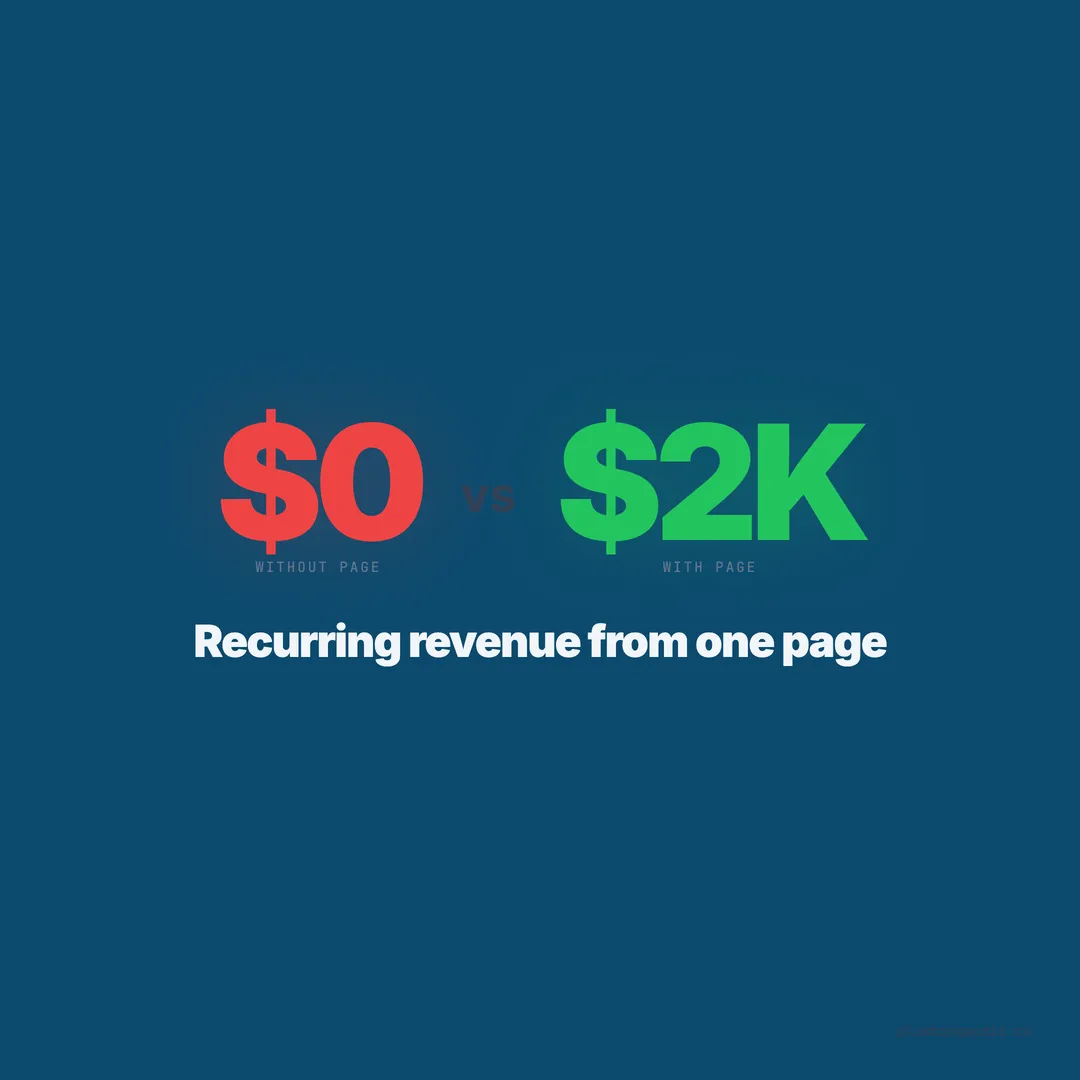
A plumbing company owner in Chandler, Arizona told us something that changed how we think about plumbing websites. She said her most valuable page wasn’t her homepage, her emergency page, or even her highest-traffic service page. It was her maintenance plan page — a page that generated only 12 visits per month but converted at 34%. Four new maintenance members per month, each paying $199 per year, each staying an average of 4.2 years. That one page generates $3,345 in projected lifetime revenue every single month.
Across 1,893 plumbing websites we’ve audited, fewer than 11% have a dedicated maintenance plan page. The vast majority of plumbing companies leave their most predictable revenue stream buried in a footer link, mentioned in a sidebar widget, or not present on the website at all. This is arguably the most undervalued page in plumbing marketing.
Maintenance plans transform one-time customers into recurring revenue
The plumbing industry’s fundamental problem is transactional revenue. A homeowner calls when something breaks, you fix it, she pays, and you may never hear from her again. The average plumbing job ticket is $445. The projected customer lifetime value for a one-time service customer is roughly $450 — barely more than the single visit.
A maintenance plan changes the math entirely. A customer on a $199/year plan who stays for 4 years generates $796 in plan revenue alone. But plan members also purchase additional services at higher rates — they’re already your customer, they trust you, and your technician is already in their home during the inspection visit. The typical maintenance plan customer generates $3,000+ in lifetime revenue, compared to $450 for the one-time customer.
That’s a 567% increase in lifetime value from a single page on your website. The industry benchmark for a sustainable plumbing business is a 3:1 LTV-to-CAC ratio. With a customer acquisition cost of roughly $150, a maintenance plan customer delivers a 20:1 ratio — exceptional by any standard.
What to include in a plumbing maintenance plan
The most successful plans in our dataset include a clear annual service package that delivers obvious value to the homeowner while creating opportunities for your technicians.
Core annual services:
- Whole-home plumbing inspection (water heater, supply lines, shut-off valves, fixtures, drains)
- Water heater flush and anode rod check
- Drain cleaning for one or two key drains (kitchen and main line are most common)
- Faucet and toilet inspection with minor adjustments included
- Water pressure test
- Hose bib inspection (seasonal, pre-winter)
Member benefits beyond the inspection:
- 10-15% discount on all repairs (standard industry incentive)
- Priority scheduling for emergencies (members go to the front of the line)
- Waived dispatch fee on all service calls (typically $49-99 value)
- Extended warranty on repairs performed (12 months vs. 90 days)
- No overtime charges for after-hours calls (high perceived value)
The pricing sweet spot for residential plumbing maintenance plans is $149-249 per year or $14.99-24.99 per month. The annual option is simpler to administer. The monthly option converts higher because the per-month cost feels smaller — $16.99 per month sounds more affordable than $199 per year, even though the annual price is actually lower.
How to structure the maintenance plan page
The maintenance plan page needs to accomplish three things: explain the value, remove objections, and make enrollment effortless. Based on the highest-converting examples in our audit, here’s the structure that works.
Headline: Lead with the benefit, not the feature. “Prevent $3,000 Emergency Repairs for $16.99/Month” outperforms “Join Our Plumbing Maintenance Club.” The homeowner doesn’t care about your club — she cares about avoiding a flooded basement.
Value proposition section: Three to four short paragraphs explaining what the plan includes and why it matters. Focus on prevention — the average emergency plumbing call costs $350-800 for the repair alone, plus water damage costs that average $3,000-7,000 for a burst pipe. An annual inspection catches problems before they become emergencies.
Plan comparison table: If you offer multiple tiers (Basic, Premium, Whole-Home), display them side by side. Three tiers is the maximum — more than that creates decision paralysis. The middle tier should be highlighted as “Most Popular.”
| Feature | Basic ($149/yr) | Premium ($199/yr) | Whole-Home ($299/yr) |
|---|---|---|---|
| Annual inspection | 1 visit | 2 visits | 2 visits |
| Water heater flush | — | Included | Included |
| Drain cleaning | 1 drain | 2 drains | All drains |
| Repair discount | 10% | 15% | 15% |
| Priority scheduling | — | Included | Included |
| Waived dispatch fee | — | Included | Included |
| No overtime charges | — | — | Included |
Social proof: Testimonials from current plan members. “We caught a slow water heater leak during our inspection that would have destroyed the utility room floor” is more persuasive than “Great service, highly recommend.” Specific stories about prevented disasters sell maintenance plans.
Cost comparison: Show the math. An annual plan costs $199. A water heater replacement costs $1,200-2,800. A slab leak repair costs $2,000-6,000. A burst pipe with water damage costs $3,000-10,000. The plan is insurance against catastrophic costs, and the numbers make the case better than any sales pitch.
The enrollment form must be simple
The biggest conversion killer on maintenance plan pages is a complicated enrollment process. If the homeowner has to call, wait on hold, and speak to someone to sign up, you’ve added friction that drops conversion rates dramatically.
The best maintenance plan pages include an inline enrollment form with these fields — and only these fields:
- Name
- Address (for scheduling the first inspection)
- Phone number
- Plan selection (radio buttons, not a dropdown)
- Payment method (credit card, processed through Stripe, Square, or your field service software)
That’s it. Five fields and a submit button. The homeowner should be enrolled within 60 seconds of deciding to sign up. No PDF agreements to download and sign. No “someone will call you back.” Instant enrollment, automatic billing, confirmation email.
Both ServiceTitan and Housecall Pro support membership plans with automated recurring billing. If your field service software handles this, embed the enrollment directly or link to it prominently from the page. The fewer steps between “I want this” and “I’m enrolled,” the higher the conversion rate.
Pricing psychology that sells plans
How you present the price matters as much as the price itself. Several psychological principles drive maintenance plan conversions.
Anchoring against emergency costs. Before showing the plan price, show the cost of common emergencies. “The average emergency drain clearing costs $375. The average water heater replacement costs $1,800. Our maintenance plan catches these problems early for $16.99/month.” The plan price feels tiny compared to the emergency alternative.
Monthly framing. $16.99/month converts higher than $199/year, even though the annual option costs less. The monthly number is easier to compare against other subscriptions the homeowner already pays — Netflix ($15.49), Spotify ($11.99), a streaming bundle ($20). A plumbing maintenance plan at $16.99 feels like another manageable subscription, not a significant purchase.
Tiered pricing with a highlighted middle. When three plans are displayed side by side, most people choose the middle option. Make your highest-margin plan the middle tier. Highlight it visually — add a border, a “Most Popular” badge, or a different background color. This nudges the decision without being manipulative.
Remove the risk. Offer a satisfaction guarantee or a cancel-anytime policy. “If your first inspection doesn’t find at least one issue worth addressing, we’ll refund your membership fee.” This removes the objection of “what if I don’t need it?” and virtually every home has plumbing issues worth catching.
Promoting the maintenance plan across your website
A dedicated page is essential, but promotion should extend to every customer touchpoint on your website.
Homepage mention. Add a section on your homepage — between services and reviews — with a brief maintenance plan pitch and a “Learn More” link. Even a single line works: “Our Protection Plan members save an average of $800/year on repairs. See plans.”
Service pages. At the bottom of every service page, add a callout: “Prevent [service] emergencies with our annual maintenance plan.” Link to the plan page. A homeowner reading about drain cleaning is already thinking about prevention.
After-hours page. After describing your emergency services, mention that plan members get priority emergency scheduling and waived dispatch fees. This is the moment the homeowner is most receptive to prevention messaging.
Post-service follow-up. After completing any repair, your confirmation email should include a maintenance plan pitch. “The [issue] we fixed today could have been caught earlier with an annual inspection. Protect your home year-round.”
Invoice footer. Every invoice — digital or printed — should mention the plan. “Ask about our annual maintenance plan: [link].” This reaches customers at the moment they’re writing a check for a repair and are most motivated to prevent the next one.
Selling the plan during service calls
Your website can generate maintenance plan enrollments, but your technicians are the best salespeople for this product. The website page gives homeowners the information; the technician closes the deal.
Train technicians to mention the plan during every service call — not as a hard sell, but as a natural recommendation. “Mrs. Johnson, the valve I replaced today would have shown early signs during an annual inspection. A lot of our customers prevent these emergencies with our maintenance plan — would you like me to sign you up before I leave?”
Companies that train technicians on plan enrollment see conversion rates of 15-25% per service call. At 20 service calls per week, that’s 3-5 new plan members per week — 156-260 new members per year. At $199 each with a 4-year average retention, that’s $124,000-207,000 in projected lifetime revenue added annually.
The website page supports this process by giving homeowners a place to verify the offer, read details, and enroll later if they didn’t sign up on the spot. 38% of plan enrollments happen within 48 hours of the service call — the homeowner goes to the website to “think about it” and the well-designed page closes the sale.
Tracking maintenance plan page performance
The maintenance plan page should be one of the most closely tracked pages on your site. Set up these metrics:
Page visits. How many people see the page each month? If the number is low (under 20), the page isn’t being promoted enough — add links from other pages, include it in email footers, mention it on your Google Business Profile posts.
Conversion rate. What percentage of visitors enroll? Below 10% suggests the page content or form needs improvement. Above 25% means the page is working well and you should focus on driving more traffic to it.
Enrollment source. Track how members find the plan page — direct from a technician referral, from another website page, from an email link, or from a Google search. This tells you which promotion channels to invest in.
Churn rate. What percentage of members cancel each year? Industry average is 15-20% annual churn for residential maintenance plans. If yours is higher, the plan may not be delivering perceived value — revisit the service package.
Revenue per member. Track total revenue from plan members versus non-members. This includes the plan fee plus all additional services purchased. When you can show that plan members generate 3-6x more revenue than one-time customers, the plan page becomes your highest-priority conversion target.
Common mistakes on maintenance plan pages
After reviewing the 11% of plumbing sites that have maintenance plan pages, we see the same mistakes repeatedly.
Burying the page. The plan page is linked only from the footer in a list of twelve other links. Move it to the main navigation. It deserves equal billing with “Services” and “Contact.”
Using industry jargon. “Annual preventative plumbing system evaluation and prophylactic maintenance protocol” means nothing to a homeowner. “We inspect every pipe, valve, and fixture in your home once a year to catch problems before they cost you thousands.” Clear beats clever.
No pricing on the page. 79% of plumbing websites don’t show pricing for anything. The maintenance plan page is the worst place to hide the price. If a homeowner has to call to find out what it costs, she won’t call — she’ll leave. Display the price prominently and confidently.
No online enrollment. A “Call to Enroll” button adds friction. An inline form with credit card processing removes it. The homeowner who’s ready to buy at 9 PM on a Tuesday won’t wait until your office opens at 8 AM Wednesday. She’ll forget or change her mind by then.
No cancellation clarity. If the homeowner doesn’t know she can cancel easily, she won’t enroll. A simple line — “Cancel anytime, no fees, no hassle” — removes the biggest objection. The vast majority of members who sign up don’t cancel, so the cancellation policy costs you almost nothing while converting significantly more visitors.
The maintenance plan page won’t be your highest-traffic page. It might be your most profitable one.
Keep reading
Want to know your score?
Drop your URL — full report in 48 hours.
We're on it.
Report in your inbox within 48 hours.