Plumbing Referral Program: How to Systematize Word-of-Mouth
65% of new business comes from referrals, but only 29% of happy customers refer without being asked. Here's how to build a referral system that compounds.
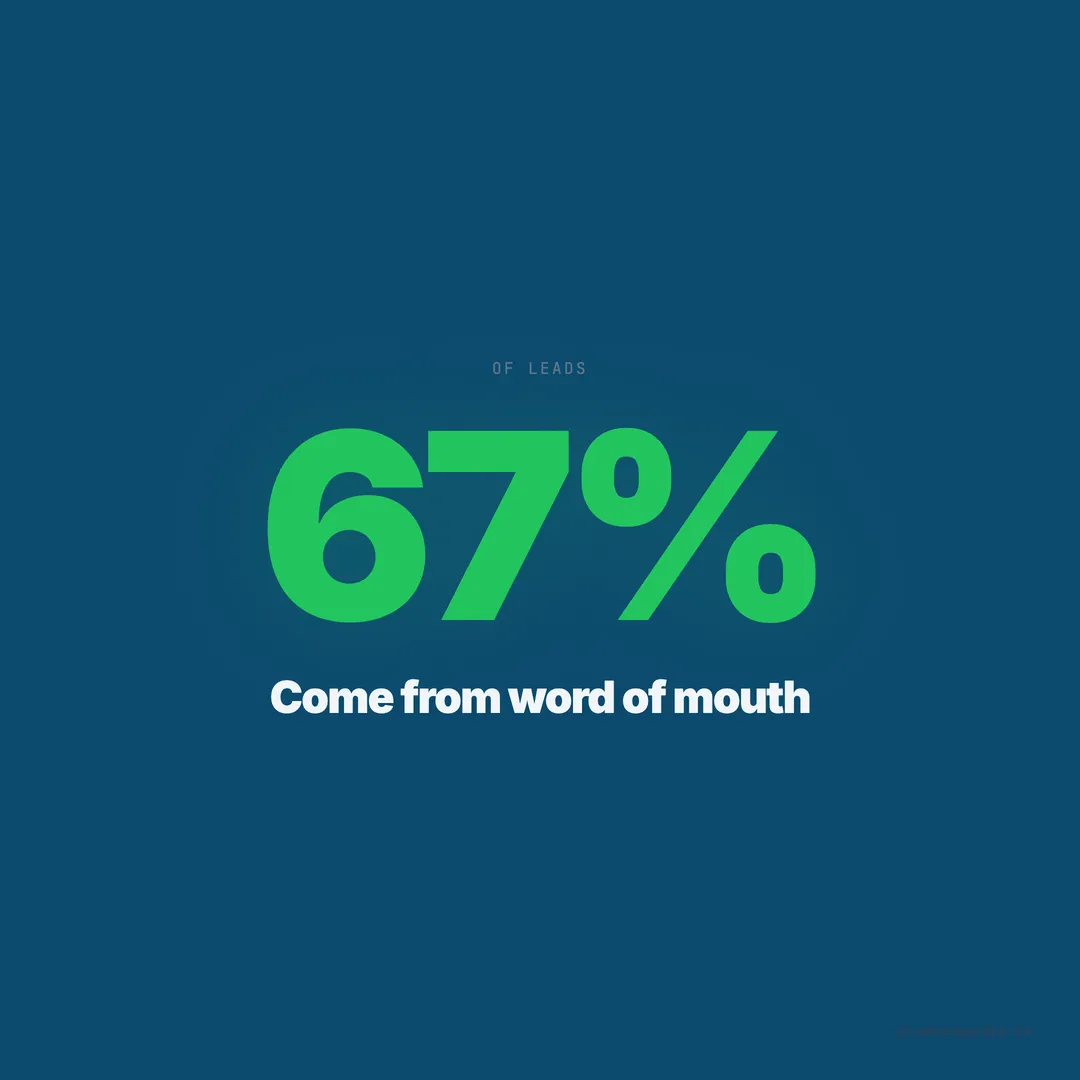
A plumber in Scottsdale told us that referrals were his best lead source. Then we asked him how many referrals he got last month. He paused. “I don’t know — maybe four or five?” He didn’t track them. He didn’t have a system. He didn’t incentivize them. He didn’t thank the referring customer in any structured way. His “referral program” was hoping happy customers mentioned his name.
He’s not alone in this. 65% of new business opportunities come from referrals and recommendations. Referred customers have a customer acquisition cost that is $23.12 less than non-referred customers. Companies with formal referral programs see 24% lower acquisition costs overall. Yet across 1,893 plumbing websites we’ve audited, fewer than 7% mention a referral program anywhere on their site.
The gap between “referrals are great” and “we have a referral system” is where most plumbing companies lose thousands in potential revenue every year.
Why referrals outperform every other lead source
Referral leads convert at 3-5x higher rates than leads from advertising. When a neighbor tells a homeowner “call Mike’s Plumbing, they fixed my water heater last month and were great,” that recommendation carries more weight than any Google ad, any website design, or any trust badge.
Over 90% of consumers trust word-of-mouth referrals more than any other form of marketing. The trust is pre-built. The referred customer arrives already believing you’re competent, fair, and reliable — beliefs that normally take a website visit, a phone call, and a completed job to establish.
The economics are equally compelling. The average customer acquisition cost for plumbing companies through paid channels ranges from $150-400. Through referrals, that drops to $15-30 per acquisition when you factor in referral incentives and program management. At a $445 average ticket and a customer lifetime value of $450-3,000+ (depending on whether they join a maintenance plan), referral leads deliver the best ROI of any marketing channel.
Companies that invest in referral programs see an 86% increase in revenue growth compared to those that don’t. That’s not a marginal improvement — it’s a transformational one, built on a channel that most plumbing companies treat as an afterthought.
The referral gap: 83% would refer, only 29% do
Here’s the statistic that should keep plumbing company owners up at night: 83% of satisfied customers say they’d refer a brand, but only 29% actually do. That’s a 54-point gap between willingness and action — and it exists because nobody asks.
People don’t refer businesses they’re satisfied with. They refer businesses that make referring easy and rewarding. The asking is the mechanism. Without it, even your happiest customers will simply enjoy their fixed plumbing and go about their day without mentioning your name to anyone.
A structured referral program closes the gap by solving three problems. First, it reminds the customer to refer — timing the ask when satisfaction is highest. Second, it makes referring effortless — providing a link, a card, or a code they can share in seconds. Third, it rewards the behavior — giving the referrer a tangible reason to take the action.
The best plumbing referral programs in our dataset convert 12-18% of customers into active referrers. That’s still below the 83% ceiling, but at 12% of a customer base of 500, that’s 60 referrals per year at near-zero cost per acquisition.
Designing the incentive structure
The referral incentive needs to be valuable enough to motivate action but sustainable enough to scale. Based on what works for plumbing companies in our dataset, here are the proven incentive models.
Cash credit on next service. Offer the referring customer $50 toward their next plumbing service for every referral that books a job. This is the most popular model and the easiest to administer. The $50 cost is absorbed easily when the referred job averages $445. The credit also ensures the referring customer comes back — creating retention alongside acquisition.
Cash credit for both parties. Offer $25 off for the referred customer and $50 credit for the referrer. The dual incentive gives the referrer something specific to offer their friend: “Use my code and get $25 off your first service.” This makes the referral feel generous rather than self-serving.
Gift card reward. Some plumbing companies offer a $50 Visa or Amazon gift card instead of a service credit. The advantage: the reward is immediate and tangible, not contingent on needing future plumbing work. The disadvantage: it’s a hard cost with no built-in return visit.
Tiered rewards. Reward escalates with volume: 1st referral = $50 credit, 3rd referral = $75 credit, 5th referral = free drain cleaning (value $175-250). Tiered programs turn casual referrers into active promoters. The customers who love your work will game the system in your favor.
| Incentive Model | Cost Per Referral | Referrer Return Rate | Best For |
|---|---|---|---|
| $50 service credit | $50 (offset) | 78% rebook | Retention + acquisition |
| $25/$50 dual credit | $75 (offset) | 65% rebook | New customer conversion |
| $50 gift card | $50 (hard cost) | No guaranteed return | Maximum referral volume |
| Tiered credits | $50-250 (offset) | 85% rebook | Power referrers |
The service credit model wins for most plumbing companies because it costs less in real dollars (credits go unused 20-30% of the time) and drives repeat business from the referrer.
Building the referral workflow
A referral program isn’t a marketing campaign — it’s a workflow. It needs to trigger automatically at the right moments without requiring the plumber to remember to ask.
Trigger 1: Post-service text (within 2 hours of job completion). After the technician marks a job complete, an automated text goes to the customer: “Thanks for choosing [Company]! If you know someone who needs plumbing help, share your referral link and you’ll both save: [unique link].”
This text serves double duty — it’s also the moment to ask for a Google review. Combine them: “Happy with our service? Leave us a review: [review link]. Know someone who needs plumbing help? Share your referral link: [referral link].”
Trigger 2: Follow-up email (7 days post-service). A more detailed email explaining the referral program — what the incentive is, how it works, and a shareable link or code. Include a brief recap of the service performed as a reminder of the positive experience.
Trigger 3: Quarterly check-in. Every 90 days, send a brief email or text to your customer list reminding them of the referral program. Time these around seasonal peaks — before summer (water heater issues, AC-related plumbing) and before winter (pipe freeze prevention, drain backup season).
Trigger 4: After positive review. If a customer leaves a 5-star Google review, they’ve already demonstrated advocacy. Send a follow-up: “Thank you for the kind review! If you know anyone else who needs plumbing help, here’s your referral link — you’ll get $50 toward your next service.”
Website integration for the referral program
Your website is the hub that ties the referral system together. A dedicated referral page legitimizes the program and gives customers a place to send people.
The referral landing page should include:
- Clear headline: “Refer a Friend, Get $50 Toward Your Next Service”
- How it works in 3 steps: 1) Share your link, 2) They book a service, 3) You get $50 credit
- A form for the referrer to enter: their name, the friend’s name, the friend’s phone or email
- Terms: what qualifies (booked and completed service of $100+), how credits are applied, expiration if any
- Current customer testimonials about the referral experience
Referral page placement on the site:
Add the referral program to your main navigation or footer navigation. Link to it from your about page, your thank-you page (shown after form submission), and your post-service email sequence. The referral page should be no more than 2 clicks from any page on your site.
Some plumbing companies integrate referral functionality directly into their field service software. Both ServiceTitan and Housecall Pro support referral tracking that assigns unique codes to customers and automatically applies credits when referred jobs are completed.
Tracking referrals so nothing falls through the cracks
An untracked referral program is a broken referral program. If a customer refers someone and doesn’t receive their reward, they’ll never refer again — and they’ll tell others about the broken promise.
Essential tracking elements:
- Unique referral codes or links for each customer (generated by your CRM or field service software)
- A log of referral submissions: who referred whom, date submitted, status (pending, booked, completed, credited)
- Automated credit application when the referred job is marked complete
- Automated notification to the referrer: “Great news — [Friend’s name] just completed their service. Your $50 credit has been applied.”
Manual tracking alternative. If you don’t have software that handles this, a simple spreadsheet works for small operations. Columns: referrer name, referrer phone, referred name, referred phone, date submitted, job date, job value, credit applied (yes/no), credit used (yes/no). Review weekly. Apply credits promptly.
The key metric is referral conversion rate: what percentage of referral submissions result in a booked and completed job. Industry average for home services is 25-40%. If yours is below 25%, the referred leads may not be getting contacted quickly enough — speed to lead matters for referral leads too.
The thank-you workflow that generates more referrals
The referral cycle doesn’t end when the credit is applied. The thank-you is the mechanism that turns a one-time referrer into a repeat referrer.
Immediate automated thank-you. As soon as the referred job completes and the credit is applied, send a text: “You earned $50! Your referral credit is ready for your next service. Thank you for spreading the word.”
Handwritten note (high impact). For referrers who send multiple customers, a handwritten thank-you card from the business owner stands out. “Dear Sarah, thank you for sending the Hendersons our way. Your support means a lot to our small business.” This takes 2 minutes and costs $1. The impact on future referrals is outsized.
Annual referral acknowledgment. At the end of the year, send your top referrers a gift — a small item worth $20-40 with a note thanking them for their support. A bottle of wine, a gift card to a local restaurant, or a branded Yeti tumbler. These top referrers are generating thousands in revenue for your business. Treat them like the valuable partners they are.
Referral leaderboard (optional). Some plumbing companies create a friendly competition among their best referrers — a top-referrer-of-the-quarter award with a $100 gift card. This gamifies the process for customers who are naturally social and enjoy recommending businesses.
Technician-driven referral collection
Your technicians are in the customer’s home. They have face-to-face relationships. They should be part of the referral system.
At the end of every service call, the technician should say: “We have a referral program — if you know anyone who needs plumbing help, here’s a card with your unique link. You’ll get $50 off your next service, and they’ll get $25 off their first.” Hand them a physical referral card.
Physical referral cards work because they’re tangible reminders. The homeowner puts the card on the fridge or in a drawer. When a neighbor mentions a plumbing issue, the card triggers the referral. Digital-only programs rely on the customer remembering to find the link in their email.
The referral card should include: your company name, the incentive amounts, a QR code linking to the referral page, and a unique code pre-printed for that customer. Print runs of referral cards cost $50-100 per 500 cards — negligible compared to the revenue they generate.
Incentivize technicians too. Pay your technicians $10-25 for every referral they generate. If a technician averages 15 service calls per week and generates referrals from 10% of them, that’s 1.5 referrals per week, or 78 per year. At $445 per average job, those 78 referrals generate $34,710 in revenue — well worth the $10-25 per referral you pay the technician.
Measuring referral program success
Track these metrics monthly to know if your program is working and where to improve it.
Referral volume: How many referrals are submitted per month? Benchmark: aim for 5-10% of your monthly service calls to generate a referral.
Referral conversion rate: What percentage of referred leads become booked jobs? Target: 25-40%. Below 25%, check your speed-to-lead on referral follow-up.
Cost per referral acquisition: Total referral incentive costs divided by number of completed referral jobs. Target: $30-75 — well below the $150-400 cost of paid acquisition channels.
Referral revenue as percentage of total revenue: Track what portion of your monthly revenue comes from referred customers. Start with a baseline and grow it. Companies with mature referral programs generate 30-50% of revenue from referrals.
Repeat referrer rate: What percentage of referrers refer more than once? Above 20% indicates a healthy program. Below 10% suggests the reward or thank-you process isn’t motivating repeat behavior.
Common referral program mistakes
Not asking. The most common mistake is also the most obvious. If you don’t ask, you don’t get. Build the ask into your post-service workflow so it happens automatically.
Delayed rewards. If a customer refers someone in January and doesn’t see their credit until March, the emotional connection between the referral and the reward is broken. Apply credits within 48 hours of the referred job completion.
Complicated redemption. “Call the office during business hours to schedule a service and mention your referral credit” has too many steps. The credit should apply automatically at the next service, or be redeemable online through your booking system.
No website presence. If your referral program isn’t on your website, it doesn’t exist for the 60% of customers who interact with your business online. Build the page. Link to it. Make it findable.
Forgetting the referred customer’s experience. The referred customer arrived because someone vouched for you. Treat them like a VIP. Note in their file that they were referred, and mention it when they call: “Welcome — we’re glad the Hendersons recommended us.” This validates the referrer’s recommendation and sets the tone for another positive experience.
Word-of-mouth built your plumbing business. A referral system makes sure it keeps building.
Keep reading
Want to know your score?
Drop your URL — full report in 48 hours.
We're on it.
Report in your inbox within 48 hours.